Register Now
Airport Industry Innovation Conference
21 – 22 October · Hamburg Airport · Terminal 2, Level 2

Workshop
Sessions

23 Workshops · 2 Days

Hands-On with Industry & Airports

Curated, practitioner-led sessions where technology partners and airports tackle real operational challenges together – from AI-driven ground operations to passenger well-being and sustainable equipment pooling.

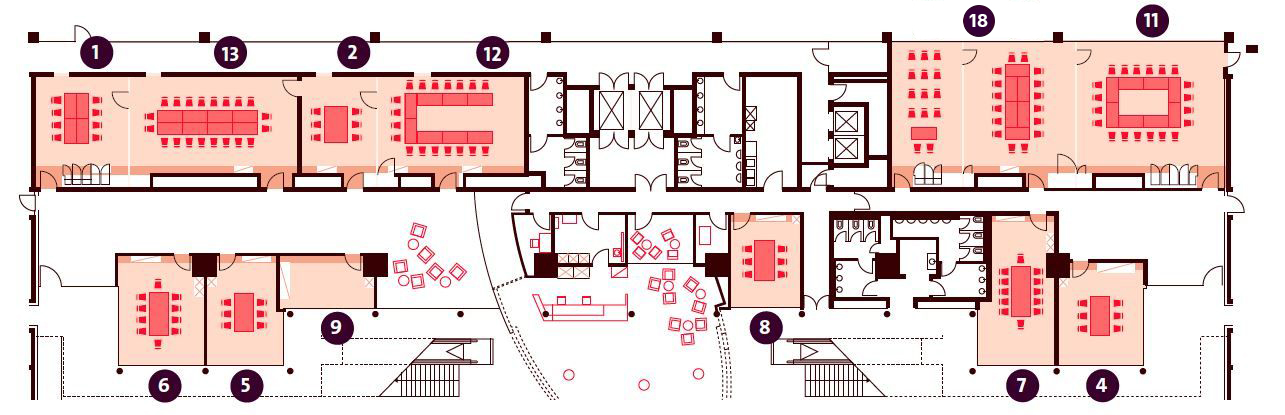
Tap a room number to see its workshops
Floor plan of the workshop rooms with room numbers
Swipe to explore the plan →
Day 121 October 2026 · 2:45 pm · 12 workshops
1Room 1 · Binnenalster

Reimagining Passenger & Staff Experiences

Format Industry-led

Airports are more than infrastructure. They are places of anticipation, connection, discovery, and human interaction. Every journey creates moments that shape how people feel, remember, and experience travel.

In this workshop, we explore the airport through the eyes of both passengers and staff to uncover opportunities for creating seamless, meaningful, and memorable experiences.

Contributing Speakers
  • Christiane Bausback – CEO, N+P Innovation Design GmbH
  • Dan Ferreira – Head of Design, Amadeus
7Room 7 · Bremen

Beyond the Silo: A Unified Connectivity Layer for the Connected Airport

Lufthansa Industry Solutions
Airline Partner

Airports track thousands of motorised and non-motorised assets across open aprons, dense terminals, baggage halls and service tunnels – environments where no single radio technology works everywhere. The result is a patchwork of silo solutions, expensive to scale and unable to feed the Airport Operations Platform. Ericsson and Wittra present a Unified Hybrid Architecture: a private 5G backbone delivering ~20 ms latency and centimetre-level RTK positioning for mission-critical GSE, combined with a low-power sub-GHz mesh layer that reaches deep indoors, plus UWB where highest precision is needed. The focus is on the data – one clean pipe into AOP and other systems via open APIs – and on the integration patterns, data-quality expectations and business case behind it, illustrated by Wittra’s live deployment across 100,000 m² at Stockholm Arlanda.

Lufthansa Industry Solutions complements Ericsson and Wittra as the system integration partner, bringing extensive aviation connectivity expertise and a strong track record of real-world airport use cases. With LEAP, a proven data integration platform, LHIND transforms connectivity and location data into actionable Location Intelligence and AI-driven operational insights.

Contributing Speakers
  • Magnus Ölund – CCO, Wittra Networks
  • Sebastian Elmgren – Head of Business Development & Product Marketing, Ericsson
  • Lasse Tiede – Head of IoT & Industrial Intelligence, Lufthansa Industry Solutions
11Room 11 · Hannover

How Physical AI, 3D LiDAR & Motional Digital Twin Transform Airport Operations

Format Industry-led

Motional Digital Twin – powered by Physical AI and 3D LiDAR – continuously captures 3D spatial data for unmatched visibility into how people and vehicles really move, improving efficiency, passenger experience and safety. With deployment examples from major international airports.

Contributing Speakers
  • Loïs Guillemaille – Regional Sales Director, Outsight
18Room 18 · Helmut Schmidt

Live Demo of Specialized AI Models for optimized Ground Handling Processes

Fraport AG
Airport Partner Frankfurt, Germany

Especially in the very dynamic environment of Ground Handling processes, it is extremely important to have a correct and consistent logging of the process executions, but at the same time extremely difficult to obtain these correct process traces under productive circumstances. We first showcase some common pitfalls of where timestamps can become erroneous or go missing during the ground handling and would like to exchange with the audience on their experiences on this topic.

To optimize the personell and resource disposition and make insightful analyses, it is essential to have a trustful and consistent data foundation. In the current form, this is not available, which clearly highlights the current pain point. To solve this, we trained different kinds of AI algorithms to impute missing timestamps, detect wrongly set timestamps and impute those as well. In the workshop we will walk through the different steps that we took to improve the data quality and train the AI models. More specifically we will explain in-depth, how we fine-tuned a Small Language Model (SLM) on this task, as the SLM provides the best performance and gives the most reliable and accurate predictions for imputation and detection of erroneous timestamps.

At last, we will get into discussion with the audience to exchange about optimization potential of this approach and also scaling this approach to other data quality-based challenges in the aviation.

Contributing Speakers
  • Markus Liebig – Product Owner AI Systems Ground Handling, Fraport AG
  • Marius Kiskemper – Product Owner Advanced AI Solutions, Atos
  • Tobias Keßler – Atos
12Room 12 · Römischer Garten

Flow Control for ULD & Cart Logistics Goes Digital

Heathrow Airport
Airport Partner London Heathrow, UK

A digital interface between baggage handling and fleet management – a kind of “Uber” for ground handlers. Developed with Heathrow and its handlers and heading into live testing, presented as an open session on the story and the solution.

Contributing Speakers
  • Jamie Ratcliffe – Senior Baggage Product Development Manager, Heathrow Airport
  • Dennis Dahlmann – Innovations Manager, BEUMER Group
6Room 6 · Jenisch Park

Rethinking PRM: Smart Processes Through Data Integration & AI

Format Industry-led

Travel by passengers with reduced mobility (PRM) keeps growing. This interactive session shows how data-driven decisions, machine learning and AI-supported dispatching can improve PRM services – cutting waiting times, optimising coordination across the airport and making the journey smoother, more transparent and more inclusive.

Contributing Speakers
  • Dr. Eva Wille – Product Manager, INFORM
  • Niklas Kotowski – Technical Lead
8Room 8 · Alstertal

The Future of Aircraft Pushback – From Digital Hazard Awareness to Single-Operator Operations

Hamburg Airport
Airport Partner Hamburg, Germany

Aircraft pushback remains one of the most safety-critical and coordination-intensive processes on the apron. The operation traditionally depends on close cooperation between the pushback driver, the headset operator and other operational stakeholders. At the same time, airports and ground handlers are looking for ways to reduce operator strain, address staffing constraints and improve the safety, consistency and scalability of ground operations.

Hamburg Airport is currently working with Evitado Technologies on a practical step in this development: supporting the transition toward single-operator pushback through digital aircraft hazard awareness. The objective is not simply to remove a person from the process. The key challenge is to understand which visual, communication and safety functions are currently provided by the headset operator, and how technology, procedures and operator-interface design can preserve or improve these functions without transferring unacceptable workload or responsibility to the pushback driver.

The workshop will use this Hamburg Airport project as a concrete operational case study. Working in multidisciplinary groups, participants map the possible evolution of pushback across several stages and conclude with a shared Pushback Automation Roadmap, identifying the technical, operational, human-factor and safety requirements associated with each stage.

Contributing Speakers
  • Andrew Moakes – Co-Founder & Chief Product Officer, Evitado Technologies
  • Russell Pink – Head of Customer Success, Evitado Technologies
  • Burkhardt Höfer – EVP Commercial, Hamburg Airport
4Room 4 · Kiel

Secure Access to IT and OT Systems and Security Measures at Airports

Format Industry-led

The digitalisation of modern airports brings major efficiency gains – but as IT and OT systems become increasingly intertwined, from baggage handling and building automation to safety-critical command-and-control, the demands on cybersecurity, access control and the protection of critical infrastructure keep rising. This workshop covers IT/OT convergence at airports, secure remote access and zero-trust approaches, the protection of critical infrastructure and OT networks, cybersecurity risks in airport operations, network segmentation and access controls, and compliance with NIS2 and regulatory requirements – rounded out with best practices and practical solutions.

Contributing Speaker
  • G. Prestifilippo – Vorstand, PRO DV AG
2Room 2 · Klövensteen

Grounded by a 50-Cent Sensor: Proactive Obsolescence Management for Critical Airport Infrastructure

Airbus
Aircraft Partner Airbus Operations GmbH

An inconspicuous, discontinued electronic component fails – and suddenly a critical Baggage Handling System (BHS) or Passenger Boarding Bridge comes to a standstill. In the highly complex infrastructure of modern airports, obsolescence is a massive risk to passenger flow, safety, and operational budgets.

In this interactive, practitioner-led workshop, Airbus and INspares join forces to show you how to exit the expensive 'firefighting' mode. We will demonstrate how proven obsolescence management frameworks from aircraft manufacturing can be successfully adapted for airport operations. Following a strategic overview of lifecycle management and smart procurement solutions, participants will engage in a hands-on "Airport Asset Risk Map" exercise. Working in small groups, you will evaluate realistic airport scenarios, assess business impacts, and discuss strategic management decisions to sustainably secure your operational resilience.

Contributing Speakers
  • Thomas Müller – Obsolescence Manager Industrial Maintenance, Airbus Operations GmbH
  • Carsten Finke – Founder & Obsolescence Manager, INspares GmbH
  • Michael Götz – BVS Electronics
5Room 5 · Stadtpark

Elevating Airport Operations: Cross-Belt Technology and Continuous Improvement Towards Digitalisation

Zurich Airport
Airport Partner Zurich, Switzerland

Zurich Airport and Leonardo will present a real-world MBHS® Cross-Belt Sorter implementation case study, highlighting the operational needs that drove the project, the challenges encountered, the solution adopted, and the results achieved. The session will also demonstrate how digitalisation, data collection, and continuous development contribute to improving the performance, maintenance, and overall efficiency of modern baggage handling systems.

Contributing Speakers
  • Pierre-Alain Vienne – Head of Baggage Systems Engineering and Operational Facilities, Flughafen Zürich AG (FZAG)
  • Felipe Knaesel Koch – Head of Strategy & Innovation, Leonardo Automation
13Room 13 · Außenalster

From Pilot to Implementation: Robot Fleet Automation for Airside Operations

Format Industry-led

Automated inspection and monitoring technology has proven itself in airport trials, but moving from a successful pilot to daily operations raises a different set of questions: who is in charge of the fleet, how many robots are actually needed, and how does it fit into schedules and systems that already exist. In this session, we will walk through the technology and share real examples from airports we’ve worked with. The second part is a working discussion: we want to hear how your airport runs inspections today, and the challenges that might arise in bringing this technology into your operations.

Contributing Speaker
  • José Luis Gil Yepes, PhD – CCO, Roboxi
9Room 9 · Rondeel

From Badge Silos to a Policy-Driven Identity Fabric – When Access Thinks Like a Flight Schedule

Format Industry-led

Rethinking real-time access: what happens when traditional access concepts meet the dynamics of a modern airport operation? When five different service providers, crews and systems must work together seamlessly within just 35 minutes, yet access logic still originates from a static world? The workshop moves away from rigid roles and isolated badge systems towards an intelligent, policy-driven identity fabric that makes decisions in real time.

Using the turnaround of a Boeing 737 as a practical use case – crew change, cleaning, catering, refuelling and ground handling all at once – the session examines how Attribute-Based Access Control (ABAC) and edge technology bring decision-making directly to the jet bridge, gate or apron entry: who is permitted, where, when and why. Together we explore the transition from fragmented badge systems to an integrated identity fabric, how policy-as-code enables transparency, auditability and speed, how edge controllers decide autonomously even during system outages, and concrete implementation steps from short-term to strategic.

Contributing Speaker
  • Alexander Friesen – Director R&D & CTO, Primion Group
Day 222 October 2026 · 10:45 am · 11 workshops
1Room 1 · Binnenalster

The Oracle of Delphi – The AI Evolution of a Digital Twin

Cologne Bonn Airport
Airport Partner Cologne, Germany

Geometrically accurate digital twins linked to real process models, now evolved into an AI-supported forecasting tool across operational, tactical and strategic horizons – developed with Cologne Bonn Airport, with a clear look at cost, benefit and return.

Contributing Speakers
  • Tom Alexander Heuer – Managing Director, Airport Research Center
  • Dr. Manuel Henrich – Head of AI Development, Airport Research Center
  • Jörg Stetza – Slot & Capacity Manager, Cologne Bonn Airport
18Room 18 · Helmut Schmidt

Making GSE Pooling a Success

Düsseldorf Airport
Airport Partner Düsseldorf, Germany

Sharing ground support equipment across handlers – transparently and reliably. A first-hand look at the centralised non-motorised pool at Düsseldorf with 700+ units, SmartFLEET telematics, and the trust framework that makes it work.

Contributing Speakers
  • Wolfgang Fasching – Head of Commercials, HiSERV
  • Martin Ideler – Dipl.-Ing., Leiter Fahrzeugmanagement, Düsseldorf Airport
13Room 13 · Außenalster

Virtual Twins and Digital Twins for the Airports of Tomorrow

Baden-Airpark
Airport Partner Karlsruhe/Baden-Baden, Germany

In the first part, we’ll showcase the use of VIRTUAL TWINS at airports to market a wide variety of areas, such as: airport advertising, retail, food and beverage, event venues, real estate, etc. These 3D models are also used for HR and wayfinding, and the data can be utilized for social media campaigns. Karlsruhe/Baden-Baden Airport has been using the tool produced by GPIXS for over a year, and we’re happy to demonstrate its various functions.

The second part deals with the highly complex topic of the DIGITAL TWIN. Airports are among the most complex infrastructure systems of our time – buildings, technical systems, security zones, traffic flows, construction projects, maintenance, ESG requirements and regulatory audit obligations are constantly intertwined, while the information needed to manage them is scattered across plans, audit reports, CAFM systems, GIS data, BIM models, spreadsheets, photos and project documentation. The session explores how airports can turn these heterogeneous data sets into a connected, spatially referenced basis for decision-making: the digital twin as an operational data model for facility management, renovation planning, construction progress monitoring, security, safety inspections, defect management, reporting and, in future, simulations such as visitor flow or capacity analyses. Together with the participants, specific airport use cases will be prioritized, relevant data sources identified, and a pragmatic vision for an “Airport Intelligence Layer” developed.

Contributing Speakers
  • Andreas Breitschaedel – Founder & CEO, GPIXS GmbH
  • Claus Grunow – Managing Director, BADEN-AIRPARK GmbH · Karlsruhe/Baden-Baden Airport
  • Matthias Hosp – CEO & Founder, GEOBILITY Systems GmbH
5Room 5 · Stadtpark

The Future of Airport Perimeter Protection – LiDAR Sensor Fusion & 3D Surveillance

Format Industry-led

As airports face increasing demands for safety, operational continuity, and resilience against evolving security threats, traditional perimeter protection systems are reaching their limits. This workshop explores the next generation of intelligent airport security based on the fusion of LiDAR and camera technologies. By combining the precise 3D spatial awareness of LiDAR with the rich contextual information provided by visual imaging, sensor fusion enables highly reliable detection, classification, and tracking of intrusions while significantly reducing false alarms caused by wildlife, weather, or environmental factors.

Contributing Speakers
  • Andreas Hofmann Director Business Development, Amorph Systems GmbH
  • Karl-Heinz Biersack Director Business Development Airport, Dallmeier electronic
4Room 4 · Kiel

From Rigid Rosters to Resilient Airport Operations: How Scenario Planning and Flexible Shift Models Ease Staff Shortages

Format Industry-led

In a volatile operating environment, airports have to avoid staffing bottlenecks, safeguard service quality and become more attractive as employers at the same time. The workshop shows how modern scenario planning and more precise demand forecasting help to simulate different traffic and operational scenarios early and to take well-founded staffing decisions. Using practical examples, the session discusses how more individual shift models for employees can be combined with operational stability – focusing on concrete questions from daily airport operations: how to better model demand shifts, peak times or short-notice disruptions, how planners can compare options faster, and how this produces workforce planning that is both more resilient and more employee-friendly. Participants gain insight into methods, typical challenges and a structured approach to making airport workforce planning fit for the future.

Contributing Speakers
  • Lana Jansen – CEO, WePlan Software GmbH
11Room 11 · Hannover

Autonomous Driving at the Apron

Format Industry-led

In a short, interactive discussion, participants jointly assess infrastructure-based marshalling as a stepping stone toward autonomous apron operations – weighing the potential benefits for safety and efficiency, the technical and operational requirements, limitations and regulatory considerations, the preconditions for an infrastructure-based approach, and hybrid models that combine vehicle-based and infrastructure-based solutions. Attendees leave with practical ideas for initial implementation.

Contributing Speakers
  • Edgar Ziller – Director Partner Management Airports, T-Systems
  • Christer Neimöck – Senior Manager Autonomous Driving, T-Systems
  • Matthias Burchert – T-Systems
6Room 6 · Jenisch Park

Airport Digitalization Initiatives – Global Trends, Roadblocks and the Way Forward for German Airports

Format Industry-led

How leading airports across Europe, North America, APAC and MEA are driving digital transformation to improve operational efficiency, passenger experience and data-driven decision-making. Participants gain a worldwide perspective on current digitalization trends, review best-in-class examples and discuss what German airports can learn from international frontrunners. A key focus is the identification of implementation roadblocks – data strategy, IT architecture, governance, organisational silos, vendor ecosystems and regulatory constraints – with interactive exercises to assess barriers and define actionable pathways for the DACH airport environment.

Contributing Speakers
  • Christophe Mostert – Founding Partner, M2P Consulting
  • Kristof Boettcher – Partner, M2P Consulting
  • Bert Dijk – Senior Manager, M2P Consulting
  • Jakob Albrecht – Manager, M2P Consulting
2Room 2 · Klövensteen

AI in the Mid-Market – Europe's AI Moment and What It Means for Airports

Format Industry-led

Beyond the vision: a five-step framework for operationalising AI in complex, regulated organisations. Featuring the Lenze transformation as a working case study, plus a guided self-assessment for participants.

Contributing Speakers
  • Annekatrin Konermann – Manager AI & Implementation, Lenze
  • Dr. Moritz Belling – Family Shareholder, Lenze
7Room 7 · Bremen

Digital Resilience in the Age of AI: Three Building Blocks for Practice

Format Industry-led

AI is changing the rules of IT resilience in both directions: it creates new attack surfaces and dependencies, yet at the same time offers powerful tools to make existing and new systems more robust. This workshop examines three key dimensions every organisation should keep in view when it comes to AI and resilience.

1. AI as a shield – strengthening IT security with AI. How can AI be used to detect security gaps and make IT systems more resilient? A live demo shows how AI can help uncover vulnerabilities in existing systems – and what this means for your own security strategy.

2. Sovereign architecture – avoiding vendor and geo lock-in. Sourcing AI solutions from a single platform or a single country is a strategic risk. We discuss design principles for vendor-independent AI architectures: open-source models, multi-cloud strategies and regulatory requirements for digital sovereignty.

3. Securing quality for the long term – test automation for AI solutions. AI models drift, training data ages, outputs change. How do you establish robust quality assurance? We show what test automation for AI systems can look like – from evaluation frameworks to continuous monitoring in operation.

For executives and technical experts who want not only to introduce AI but to run it stably and securely over the long term. Participants leave with a clear understanding of the three resilience dimensions and concrete options for action in their own organisation.

Contributing Speakers
  • Toni Fetzer – Lead Artificial Intelligence, cronn GmbH

  • Ralf Waldstein – Lead Technical Operations, cronn GmbH

12Room 12 · Römischer Garten

AI in Baggage Networks – From Lost Bag to Peace of Mind

Format Industry-led

What happens when a cruise passenger flying into Hamburg loses their bag before boarding a ship to Norway? In this interactive workshop, Ina Eldøy from BagID takes participants through a real-world baggage disruption scenario where delayed luggage turns a dream vacation into a logistical nightmare. Together, BagID and Vanderlande will explore how smart baggage tags, connected data and AI-powered visibility can help passengers, airlines, airports and cruise operators stay one step ahead and give travellers back their peace of mind.

The session then shifts from concept to creation. Live on stage, we will use AI-assisted vibe-coding to build a baggage tracking and prediction prototype on Vanderlande's OpenAir Platform. Participants will shape the prompts, influence the functionality and see the application come to life in real time. Along the way, we will discuss security on every level, from the passenger and the handler to the data itself, including cybersecurity, trusted AI guardrails and secure data sharing across the baggage ecosystem. The result is a community-built prototype that shows how open, secure and collaborative innovation can make the journey better for the people behind every bag.

Contributing Speakers
  • Oliver Stroebel – Vanderlande Logistics
  • Ina Eldøy – BagID
9Room 9 · Rondeel

CO₂ & OPEX Reduction in Baggage Handling Systems – What Really Works?

Format Industry-led

A practical reality check on cutting CO₂ and OPEX in baggage handling. Moving beyond theory, the session combines real project data, operational experience and proven use cases to show where energy is actually consumed and which technical and operational levers deliver measurable savings. Short expert impulses, real-world examples and an open discussion round – with room to test your own assumptions against industry peers and leave with transferable recommendations for your airport.

Contributing Speakers
  • Tim-Oliver Ricke – Head of Industry Management, Lenze SE
  • Sascha Goly – Global Segment Manager Logistics, Forbo Movement Systems